
Knee Replacement Rehabilitation Physiotherapy
Assessment-Led Rehabilitation & Treatment
Condition Overview
Total Knee Replacement (TKR) surgery is performed to address severe joint wear. The post-operative recovery phase is essential for obtaining optimal functional outcomes. Graded physical therapy focuses on quadriceps activation, knee bending (flexion), straightening (extension), and restoring a normal walking pattern.
Possible Contributors
Factors that commonly play a role in this condition (individual diagnosis depends on assessment):
- Total Knee Replacement (TKR) or partial knee surgery
- Post-surgical muscle inhibition, particularly in the quadriceps
- Localized tissue swelling and surgical pain guarding
- Initial walking imbalances and reliance on assistive devices
Common Symptoms & Functional Imbalances
- Difficulty bending or fully straightening the replaced knee joint
- Quadriceps weakness making standing transfers challenging
- Post-op joint swelling and warmth around the kneecap
- Walking with an antalgic gait or relying heavily on a walker
How Physiotherapy Can Support Recovery
- •Guiding knee bending to help achieve at least 90-110 degrees of flexion.
- •Activating the quadriceps using NMES and voluntary contractions.
- •Retraining walking mechanics to transition safely away from assistive walkers.
- •Teaching safe home transfer movements and swelling management rules.
Safety Warning: When to Seek Medical Evaluation
Please consult a medical doctor or visit an emergency room immediately if you experience any of the following:
- Calf warmth, throbbing pain, and significant swelling (potential DVT)
- Discharge, widening redness, or severe pain around the incision line
- High fever or persistent chills after surgery
- Operated knee joint feeling highly unstable or giving way
* Physiotherapy is a support tool and is not appropriate for active infections, major structural fractures, or progressive neurological emergencies.
Treatment Settings
Home physiotherapy is the standard starting option for TKR recovery, ensuring safety and comfort during the early weeks. Clinic visits can begin once independent walking is achieved.
Director and Senior Physiotherapist
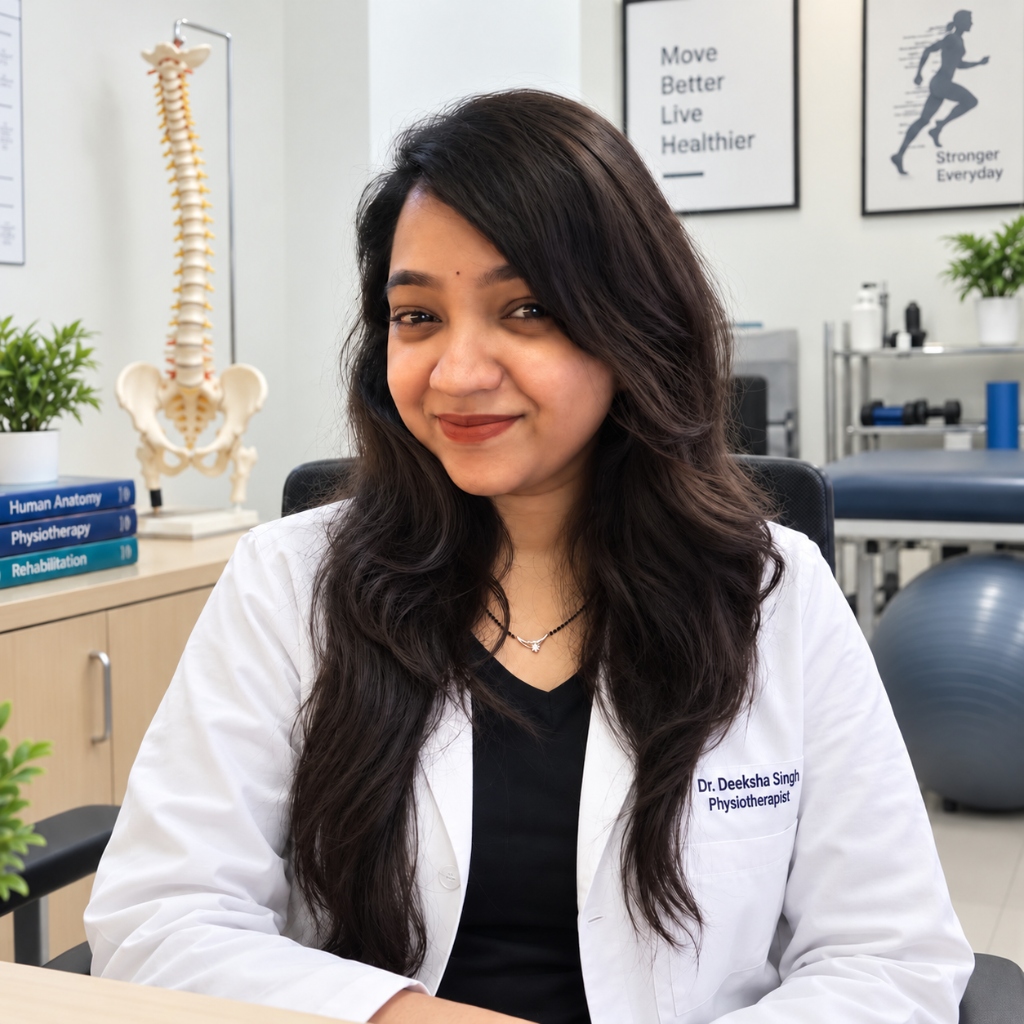
Dr. Deeksha Singh
BPT · MPT (Orthopaedics) · MIAP
All physical therapies and assessment-led roadmaps are designed and supervised by Dr. Deeksha.
View doctor profile →Your First Session
During your initial evaluation, we typically check:
- →Measurement of knee flexion and extension angles with a goniometer
- →Assessment of quadriceps contraction capability and strength
- →Checking incision healing and local swelling levels
- →Evaluation of transfer balance and walking mechanics with a walker/cane
Common Interventions
- Graded Knee Flexion & Extension Exercises
- Isometric Quadriceps Exercises & Straight Leg Raises
- NMES (Neuromuscular Electrical Stimulation) for quadriceps re-education
- Gait (Walking) Retraining & Balance Work
- Localized Cryotherapy & Elevation Protocols
Knee Replacement Rehabilitation FAQ
Frequently asked questions about therapy duration and outcomes.
What is the primary target for knee replacement rehab?
The immediate focus is on restoring knee straightening (extension) and achieving functional knee bending (flexion), alongside reactivating the thigh muscles to support independent transfers.
How long does TKR physical rehabilitation take?
Active recovery and physiotherapy support typically span 6 to 12 weeks, depending on progress and daily functional demands. Full tissue recovery continues for up to a year.
Related Rehabilitation Resources
Ready to start your recovery?
Book a clinic appointment or request a home physiotherapy visit.